
Winchester Directory Collections at Handley
The Stewart Bell Jr. Archives, operated by Handley Regional Library and the Winchester-Frederick County Historical Society, holds the main local shelf for historic directories. Its Old Houses Pathfinder states that Winchester and Frederick County directories from 1878 to the present are available in the reading room. The archive describes entries as names of inhabitants, home and business addresses, business advertisements, and occasional street lists. Treat that statement as an access window, not proof that every annual edition survives or that each volume has the same sections.
| Collection | Years | Where held | Access |
|---|---|---|---|
| Winchester and Frederick directories | 1878 to present, as stated by the archive | Handley Archives reading room | Consult in person; ask staff for the needed edition |
| Tommy McDonald directory material | Family listings 1878 to 1922; printed material 1898 to 1960 | Handley special collection | Archive request and reading-room handling |
| Winchester City Records directory | 1987 to 1988 | Handley Archives | Collection consultation |
| Historic newspapers | Selected digital material 1786 to 1925 | Advantage Preservation and Handley | Online search or archive access |
The Handley Archives collection also holds municipal records, maps, manuscripts, and research guides that can confirm the setting around a directory entry.
Note: A directory absence can reflect a listing practice or a missing edition, so it does not prove a person was absent from Winchester.
Winchester Directory Years and Gaps
The concrete runs in the McDonald collection give a stronger foundation than a generic claim about a long shelf: family listings run from 1878 through 1922, and printed Winchester directory material runs from 1898 through 1960. A historical society collection separately describes a Winchester Directory for 1878 to 1879 with the 1880 census. These holdings are valuable starting points, but the open archive pages do not name a publisher, expose an exhaustive annual checklist, or document a reverse-directory run.
Record the edition year as part of every finding. If a person appears in one edition and not the next, compare the address, any business wording, a newspaper notice, the census year, and a deed or assessment record. A change may reflect a move, death, unlisted status, a business closure, or an incomplete surviving run. It should never be reduced to a single explanation without an independent record.
Winchester Archive Reading Room Access
Handley’s archives reading room is in the lower level of the library at 100 W Piccadilly Street. Registration renews each year, visitors sign the log, and appointments are not required, though advance contact is encouraged. Researchers may bring a laptop or phone, but pencils are required. Closed stacks use green call slips, with two folders or items at a time. Three research computers and two microfilm readers support the local directory, newspaper, and map work.
The archive lists Monday, Tuesday, Thursday, Friday, and Saturday hours of 10:00 to 5:00, and Wednesday hours of 10:00 to 8:00, with a 12:30 to 1:15 lunch closure. Staff can be reached at archives@handleyregional.org or 540-662-9041 ext. 17. The Archives visit information is the best current source before travel.
The archive reading room shows the in-person setting for the collection.
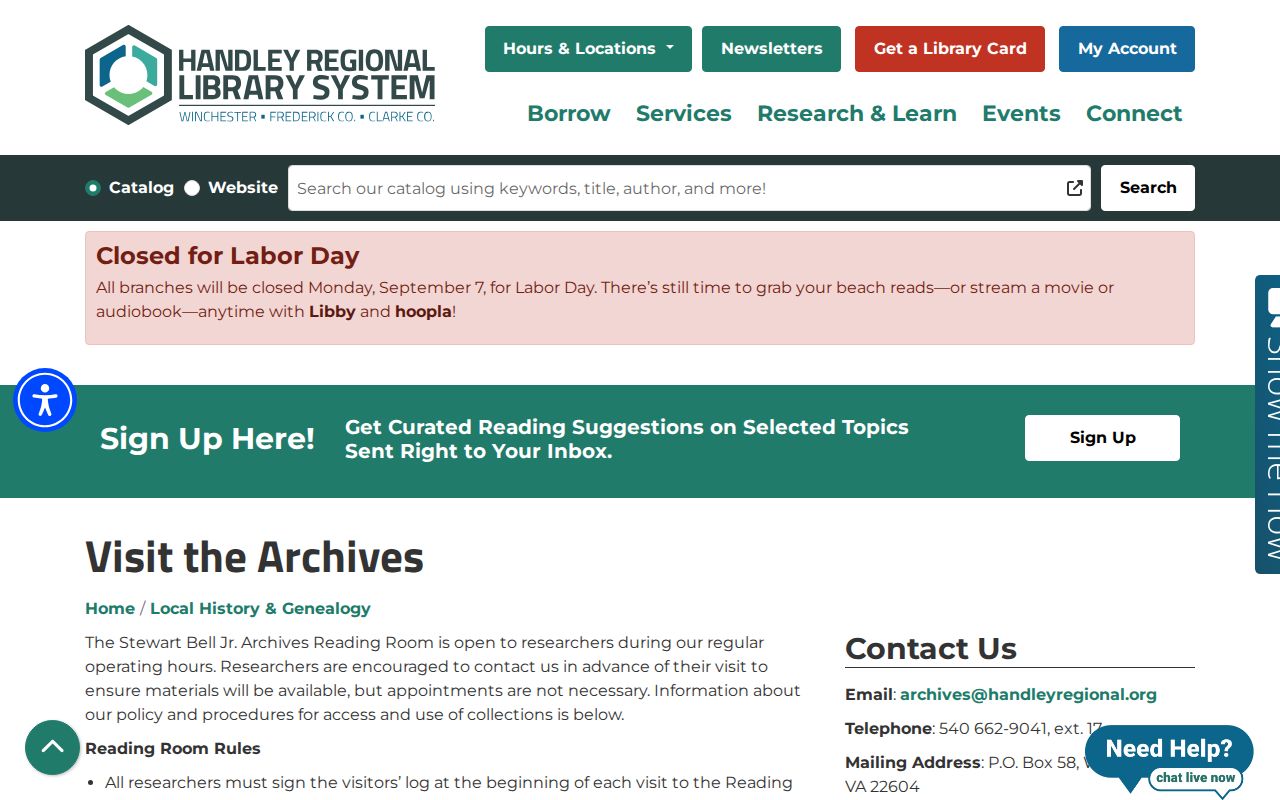
For a focused request, provide a surname, address, year, locality, and record type. Ready reference is limited to 15 minutes, and in-depth exploratory research is not promised.
Note: Copy fees, handling restrictions, donor terms, privacy, and publication permission can affect whether material may be reproduced or reused.
Winchester Directory Newspapers and Photos
When a directory edition is missing or sparse, newspapers can preserve an address, business advertisement, legal notice, obituary, or social item. Handley identifies historic newspapers as early as 1786 and Winchester Star microfilm from 1896 to the present. Its Advantage Preservation archive provides selected Winchester-area material from 1786 to 1925. Search a full street number, the street without a directional prefix, the person’s name, and adjacent years rather than assuming the modern address form was always used.
The digitized Winchester newspaper archive offers a searchable first pass for those dated mentions.
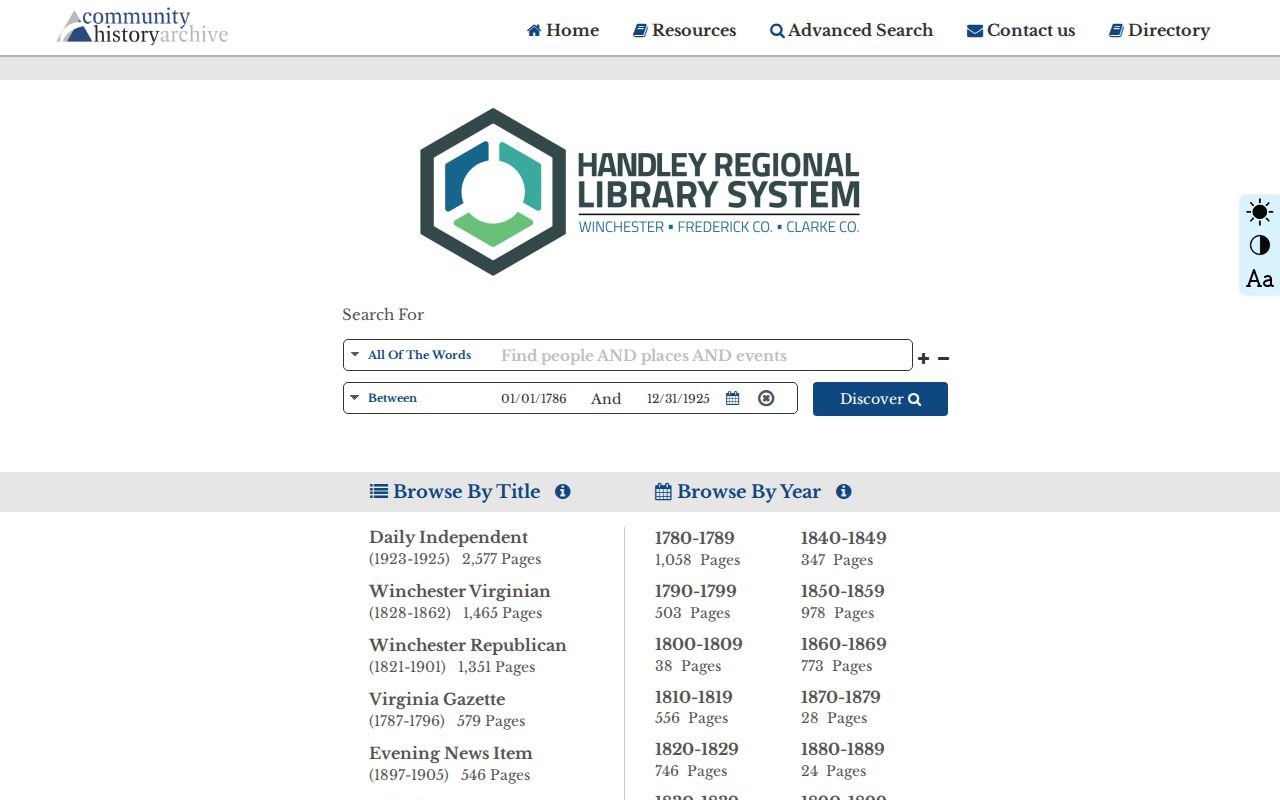
A newspaper item is still a dated publication, not a substitute for a deed, vital record, or an unbroken address history.
Winchester photographs are filed by address, while county photographs are indexed by home name. That local filing difference can turn a city-directory address into a structure clue without claiming who lived there.
Reading a Winchester Directory Entry
A Winchester directory entry should be transcribed as printed before it is interpreted. The archive says directory volumes may contain inhabitant names, home and business addresses, advertisements, and occasional street lists. The exact abbreviation key and a sample page were not available in the open sources, so do not assign a local meaning to a mark until the volume itself provides a key. Photograph or note the title page and any abbreviation page alongside the entry.
| Printed name | Use the spelling in the edition, including initials or business form. |
|---|---|
| Address | Record the house number, street wording, and whether the entry is residential or business-related. |
| Occupation or business | Capture it only when the volume prints it; it may help distinguish same-name entries. |
| Household or advertisement context | Note whether the entry appears in a family, business, advertiser, or street-list section. |
| Edition year | Preserve the publication year because the entry describes that directory period. |
- Criss-cross directory
- An address-to-name arrangement. Handley confirms occasional street lists but no identified local standalone run.
- Householder index
- A name-oriented listing for a household. Check the volume’s own organization before assuming one exists.
- Abbreviation key
- The legend printed by a directory publisher, when present; copy it before decoding entry shorthand.
When the entry lacks a clear key, preserve the printed mark as part of the transcription and ask Archives staff whether the volume supplies an introductory explanation.
Winchester Directory Evidence Compared
Printed directories and deeds provide different forms of evidence. A directory can put an occupant, business, or address in a publication year. A deed records a title transfer and legal description. An assessment card supplies a current assessment view, with a situs address and owner field that may differ from the mailing address. Newspapers and photographs add context. This comparison is especially useful when a family stayed in a building across a transfer, or when a business used an address without owning it.
The address-focused material belongs with the Winchester Streets reference, where parcel cards, GIS layers, permit files, and recorded-instrument routes are treated in detail. For historical directory work, preserve each source’s role and date rather than turning a stack of clues into an undated resident claim.
Winchester Directory Timeline Clues
A short timeline keeps the collection boundaries visible. In 1878, the archive’s stated Winchester and Frederick directory window begins. The McDonald collection documents family listings through 1922 and printed directory material through 1960. The Winchester City Records collection adds a 1987 to 1988 directory. Those reference points identify known access, not a claim that the archive holds every edition between them.
- 1878: Handley states the local directory availability begins with this year.
- 1878 to 1922: Tommy McDonald collection family listings provide a documented run.
- 1898 to 1960: Tommy McDonald collection printed directory material provides another documented run.
- 1987 to 1988: Winchester City Records includes a local directory.
Sanborn dates provide a separate structure timeline: 1885, 1891, 1897, 1903, 1908, 1912, 1921, and 1927. They can help tie a printed address to a building footprint or use, but they do not list occupants.
Note: The year ranges identify known holdings and should not be read as a guarantee that every intervening annual edition survives.
Tracing a Winchester Directory Household
Trace a Winchester household through one edition at a time. Start with a known name or address, save the exact printed form, and check nearby editions for a move, new business wording, or disappearance. Pair directory years with the nearest census year, but do not make the census stand in for the directory period. Then test the address with a deed, assessment, newspaper, Sanborn map, or address-indexed photograph according to the question at hand.
- Find the first documented directory appearance and capture the edition year and printed entry.
- Search the next available editions for the same name, address, and street wording.
- Check occasional street-list pages or ask the archive whether a reverse or criss-cross source exists for that year.
- Pair the address sequence with the closest census, newspaper, map, or property source.
- Record whether the evidence identifies an occupant, business, owner, transfer party, or photograph subject.
Handley’s databases include digital newspapers, library-computer research resources, and online PastPerfect material. Use each result as a route back to the archive image, catalog, or primary record when possible.
Winchester Directory Digital Catalogs
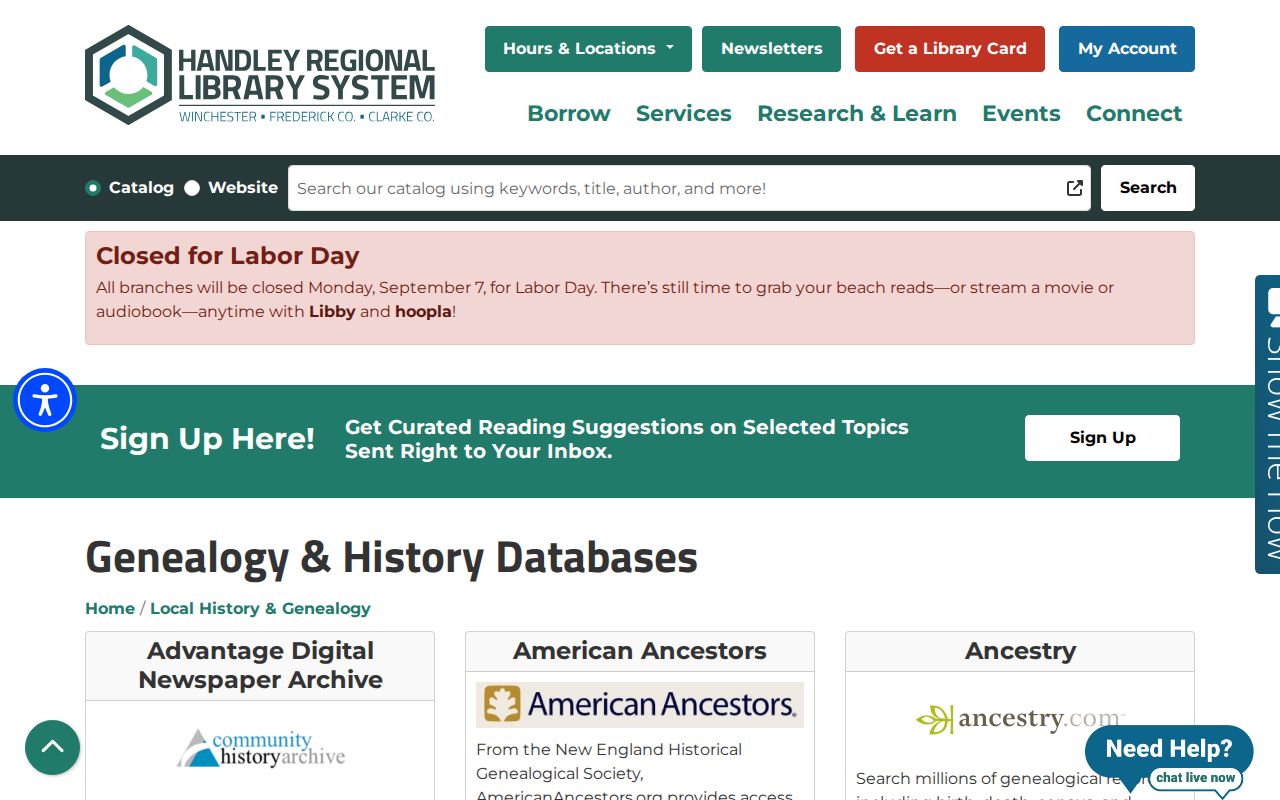
Handley’s database list includes Advantage Digital Newspaper Archive, American Ancestors and Ancestry on library public computers, expanded FamilySearch access on library computers with a free account, Fold3 remotely with a library card, HeritageQuest remotely with a library card, Newspaper Archive with a library card or account, and PastPerfect online. Access conditions vary, so a search result should lead back to the cited collection or image rather than becoming the final evidence.
The Archives databases page identifies those channels and their access conditions.
The Handley PastPerfect collection search is a public route to part of the image collection.
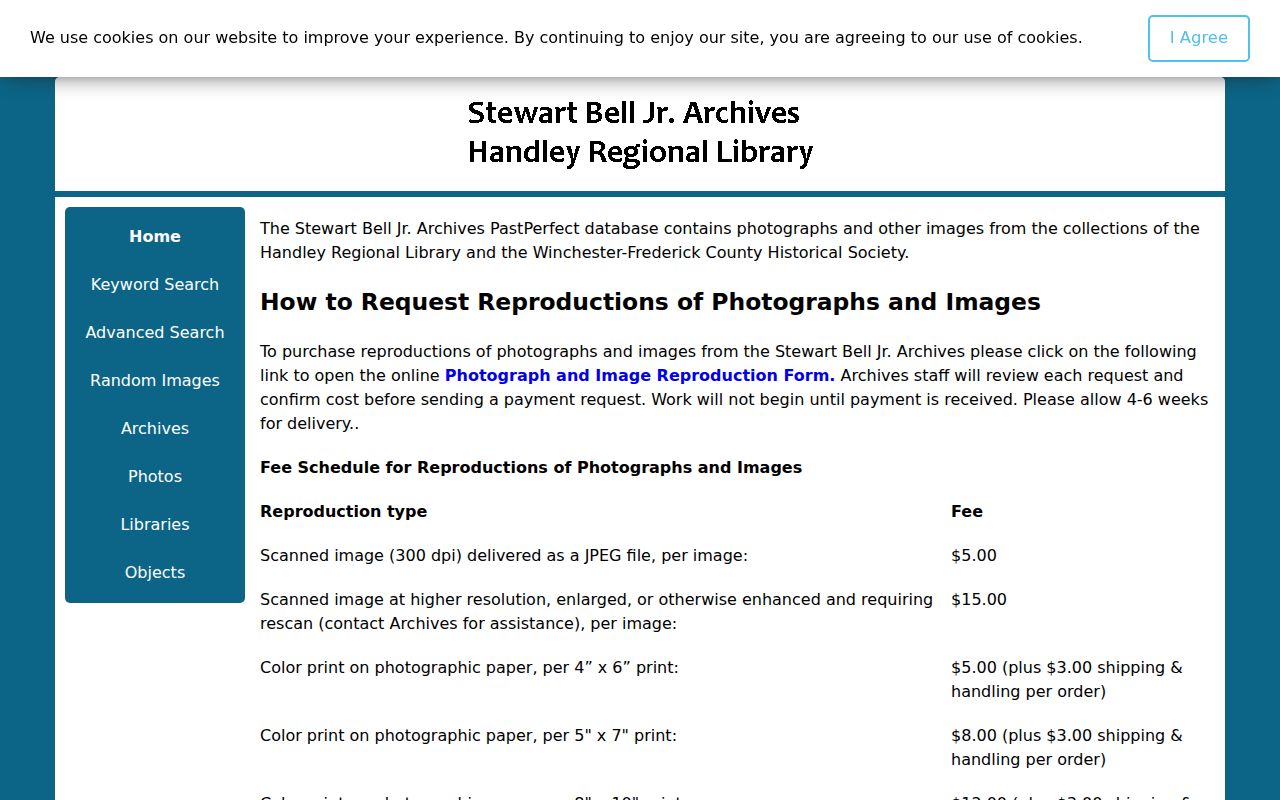
PastPerfect can support an address-to-image search, while archive handling rules and reproduction permissions still govern the underlying material.
Note: Database access can depend on a library computer, a library card, or a free account, so confirm the current access condition first.
Winchester Directory Limits
Historic printed directories are powerful because they preserve a dated local snapshot. They do not certify title, family relationship, current presence, or a complete private household. The archive does not promise a complete annual run, and the official open pages did not confirm specific reverse-directory years, telephone-book runs, or shelf call numbers. Ask staff for the exact year and format instead of assuming a name is searchable by address.
For an in-person or remote request, give Handley the city or county locality, full address or surname, year range, and source type. If the question concerns an early recorded instrument, Library of Virginia city and Frederick County microfilm catalogs offer separate trails. Keeping city, county, postal, and publication-year labels intact is the best safeguard against a false match.